-
Title
-
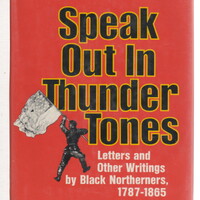
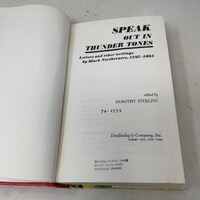
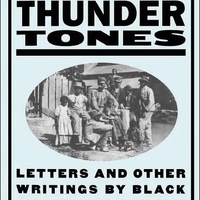
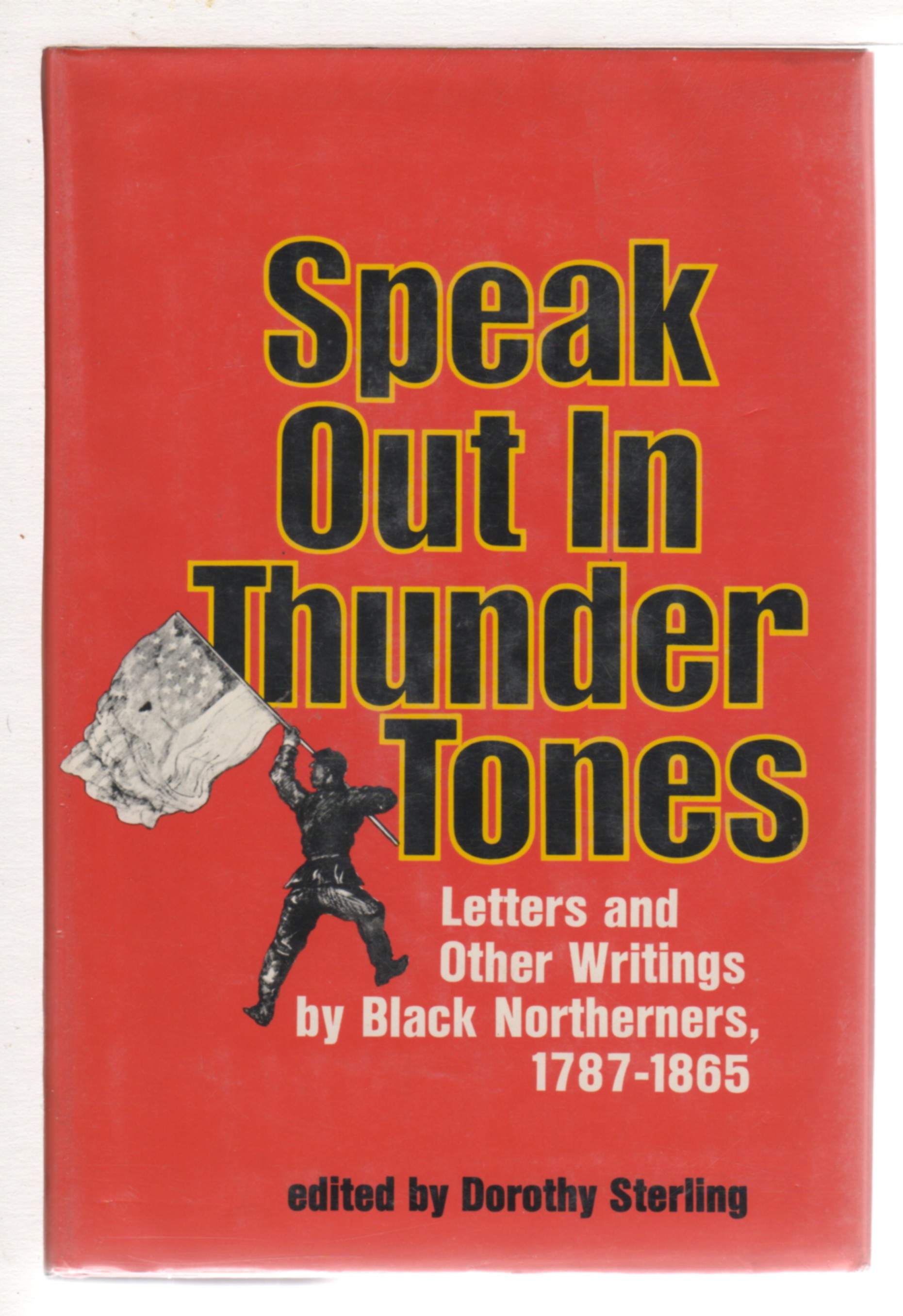
Speak Out in Thunder Tones: Letters and Other Writings by Black Northerners, 1787-1865.
-
This edition
-
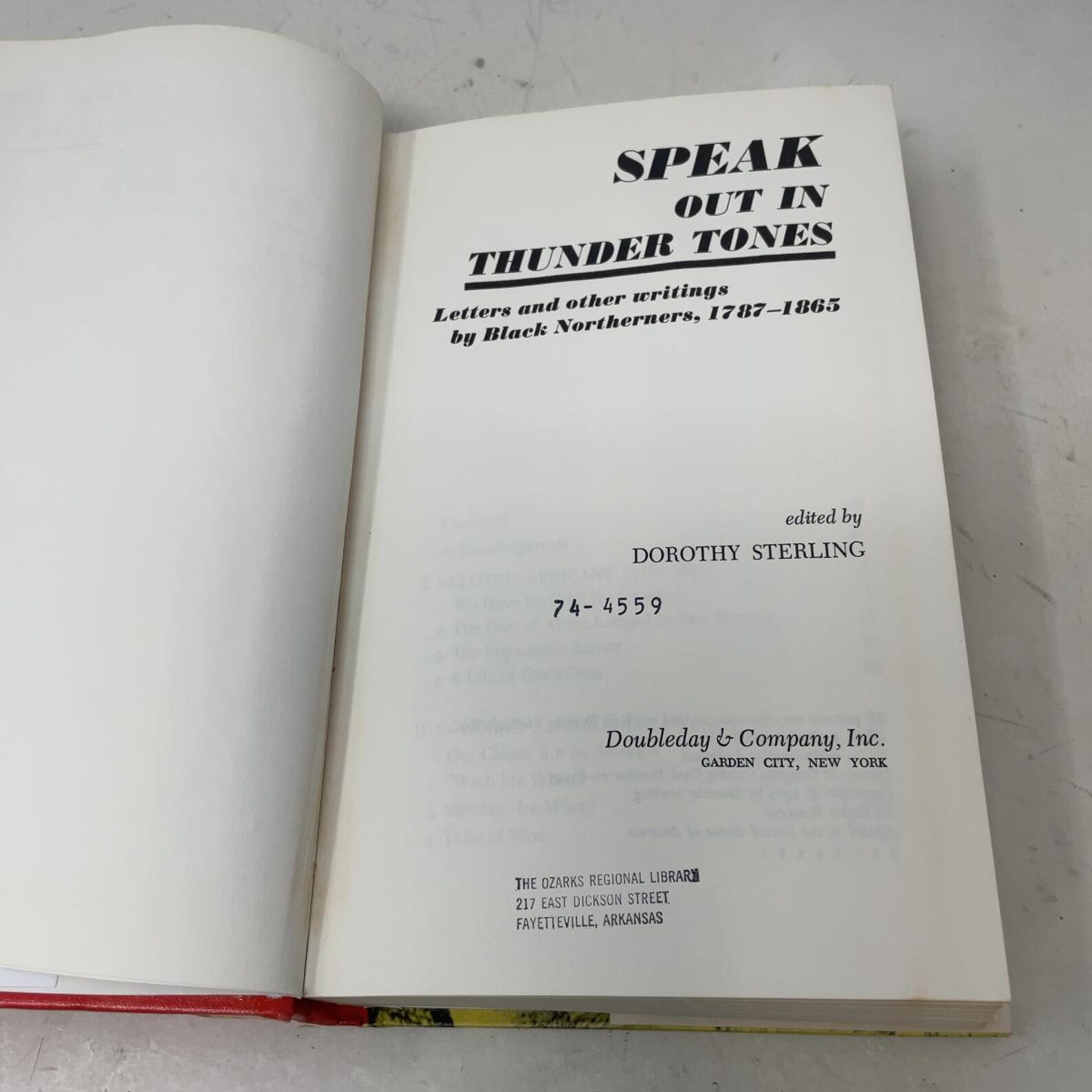
"Speak Out in Thunder Tones: Letters and Other Writings by Black Northerners, 1787-1865." Ed. Dorothy Sterling. Garden City, NY: Doubleday, 1973. xvi+396 pp.
-
Other editions, reprints, and translations
-
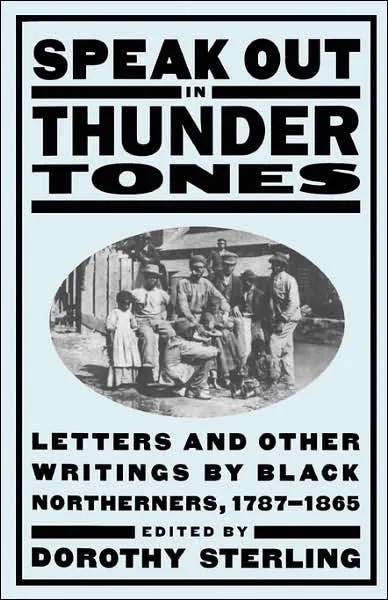
● Reprinted by Da Capo Press, 1998.
-
Table of contents
-
● Dorothy Sterling / Foreword
● Acknowledgments
I. Beloved Africans (1787-1830)
1. We Have No City! No Country!
2. The Dust of Africa Lodged on Our Rigging
3. The Impassable Barrier
4. A Life of One's Own
II. Colored Americans (1830-40)
1. Our Claims Are on America
2. "Wash Me White"
3. Striving--for What?
4. Tales of Woe
III. We Are Men (1840-50)
1. We Need More Radicalism
2. On the Antislavery Circuit
3. Hug Those Gentlemen!
4. Kidnappers!
5. Time for a Change
IV. Some People, Ordinary and Extraordinary)
1. The Black Family
2. Making It in the North
3. Black Pioneers
4. Globetrotters
5. Gift of Story and Song
V. It Was Nation Time (1850-60)
1. Black Is a Very Pretty Color
2. School Days
3. I Intend to Fight
4. The Colored Patriots
5. By Any Means Necessary
6. Where Shall We Go?
VI. O, Freedom (1861-65)
1. A White Man's War
2. Many Thousands Gone
3. The Colored Volunteer
4. Copperhead, Johnny Reb and Uncle Sam
5. They Also Served
6. Victory--and Then?
● Biographical Directory
● Index
-
About the anthology
-
● Sterling notes in her foreword that the anthology consists of extracts, rather than whole works, and these are composed into "a narrative--more or less chronological--of black life in the United States" [or, rather, in the free black communities of the Northern states?] (x): "In this book, then, free blacks who lived in the North between 1787 and 1865 tell their story. The text, except for my introductions, was written by them. Almost all of it will be new to modern readers" (x).
● "Sources are given after each selection, except in the open//ing sections where, as indicated, the bulk of the material comes from manuscript collections in Newport and New Bedford. The first time a writer's name is mentioned, he is briefly identified. For further information there are thumbnail sketches of the most important men and women of the period at the end of the book" (x-xi).
● Sterling also notes in her foreword: "To make the selections more readable, spelling and punctuation have been modernized. Although extensive cuts have been made, the original meaning of the writer has not been altered. Where an occasional word has been inserted to make this meaning clear, my additions are in brackets. In only one way have I tampered with the material. When white writers interviewed blacks or took down their speeches, the blacks' language, as reported, was often heavy with 'dem,' 'dat,' 'dose,' 'gwine' for 'going,' 'lobe' for 'love,' and so forth. I have removed all of this dialect with a clear conscience. There _were_ regional and class differences in speech, of course, but the reporters, sympathetic though they were, glossed over these real differences in favor of a stereotype" (xi).
-
Publisher's description
-
● "This impressive collection, drawn from a wealth of original research into previously untapped sources—including letters, diaries, memoirs, speeches, poems, songs, newspaper articles, advertisements, a ship's log, and official documents—allows African Americans to speak afresh across more than two centuries. Besides the expected voices of Frederick Douglass and Sojourner Truth, this book makes vivid the experiences and views of a diverse range of lesser-known but equally fascinating personalities: Ira Aldridge, one of the great Shakespearean actors of his day; William Allen, the first black college professor in the country; the astronomer and mathematician Benjamin Banneker; Paul Cuffe, owner of a fleet of merchant ships; Martin R. Delany, the father of black nationalism; James Forten, war veteran, inventor, and one of the wealthiest men in America; the militant Henry Highland Garnet, who urged slaves to revolt; the poet Phillis Wheatley, as well as ordinary free blacks, fugitive slaves, soldiers, wives, mothers, pioneers, sailors, and numerous others. The editor has forged her material into a documentary history as dramatic as it is memorable" (publisher's description).
-
Anthology editor(s)' discourse
-
● Sterling presents the writings collected in this anthology as being in the service of the recovery of African American history, upending "the century-old insistence of historians that black people had not had any role in United States history or that their role was limited to a few unique individuals. Between Denmark Vesey, Harriet Tubman, Frederick Douglass, Booker T. Washington and Martin Luther King, Jr., it seemed that there were only great blank spaces in which nothing worth recording had // happened and no one worth knowing about had lived" (vii-viii).
● The recording and recovery of African American history has been going on since at least 1841, Sterling notes, and there has been an explosion of work in the 1960s and since: "Blacks . . . have been recording their history in the United States ever since 1841 when the Reverend James W. C. Pennington, once a slave, published a small book titled, 'A Textbook of the origin and History of the Colored People.' In later decades of the nineteenth century, more ambitious works were produced by William C. Nell, Martin R. Delany, William Wells Brown and George Washington Williams. These writings were known only to a small black readership and few white scholars paid attention to them.
"In the twentieth century, there were new and more powerful challenges by such fine black scholars as Carter Woodson, W. E. B. Du Bois, Rayford Logan, Benjamin Quarles, John Hope Franklin, and by white historians like Herbert Aptheker, C. Vann Woodward and others. Though their researches and writings made significant inroads, they could not entirely reverse white Academia's long denial of the black role in United States history. They did much, however, to shape the self-image of a new black generation, which since the 1960s has achieved a fresh understanding of and a positive pride in its identity.
"The Black Consciousness explosion of the 1960s set off a publishing explosion not only of new works on black history but also of long-forgotten out-of-print books. The dust settled at the end of the decade, leaving behind a feeling that at last we know it all, and if we don't, we never will because by now, certainly, we have exhausted all the sources.
"Not so." (viii)
-
● This project grew out of Sterling's work on her biography Martin R. Delany: "The Making of an Afro-American: Martin Robison Delany 1812-1885" (Doubleday, 1971) [Internet Archive]
-
Internet Archive
-
"While I was working on a biography of Martin R. Delany in 1968-70, my hunt for facts and meanings moved repeatedly toward black sources. And I was repeatedly astonished that so much should remain to be discovered, written about, interpreted. Later, my Delany files tantalized me. I knew they held only only surface scrapings from the large body of materials I had encountered. And if the surface was that rich, who could resist digging deeper?" (viii)
-
● The present work is the first of a planned three volumes: "I began to plan a three-volume collection of letters, diaries and other writings to present the viewpoints of succeeding black generations--the records of blacks who, as individuals, had helped to make history or had commented on history in the making. Most of them lived their lives without distinction except in their own communities; many were as famous as black people could become in their time. This is volume one, which takes the story through the Civil War" (ix).
Sterling also edited "The Trouble They Seen: Black People Tell the Story of Reconstruction" (1976) and "We Are Your Sisters: Black Women in the Nineteenth Century" (1984). [See below for links to these anthologies]
-
● Sterling discusses the sources she has mined for the material presented here: "My first source was the black newspapers. Almost three dozen weekly papers edited by black men and women appeared between 1827 and 1865. Many lasted only a few months but five--'Freedom's Journal', 'The Colored American', 'The North Star' (later 'Frederick Douglass's Paper' and "Douglass' Monthly'), 'The Weekly Anglo-African' and 'The Pacific Appeal'--continued for years and are now available on microfilm. These papers have long been known to researchers but have been little used. Their editorials, news stories and, particularly, their letters to the editors provided rich and exciting insights into the black communities of the North. Here were people talking about themselves, their struggles and dreams, frustrations and achievements. The antislavery papers edited by whites, particularly 'The Liberator', supplemented the black papers. They, too, contained letters from blacks and reports of their meetings.
"The newspapers were only the beginning. Following up on hints in black history books and some hunches of my own, I visited or corresponded with university and public libraries, historical societies and the National Archives. Some had only a letter or two. In others a wealth of material turned up. Alongside reports from community leaders were letters from young men about their girls, accounts of whaling voyages, correspondence from soldiers at the front and, over and over again, tales of prejudice and discrimination.
"There were some surprises too. Perhaps the most exciting find was a dusty leatherbound notebook on loan to the Newport (Rhode Island) Historical Society. Here was the record // of an extensive back-to-Africa movement in the eighteenth century. Only twenty-five miles from Newport, in the Free Public Library of New Bedford, Massachusetts, Paul Cuffe's correspondence with blacks in Northern cities carried the movement into the first decades of the nineteenth century. The identification of American blacks with Africa at this time and their widespread interest in resettlement there has never been reported before" (ix-x).
-
● Sterling notes that she's had to omit much of the material she collected: "choices were necessary when I called a halt to my research and discovered that my bulging files contained enough for four volumes the size of this one. Reluctantly I was forced to drop the tales of slavery as seen by slaves, accounts from free blacks in the slave South and the rich literature of the black-run Underground Railroad. I have also refrained from quoting extensively from Frederick Douglass, David Walker and one or two others whose writings are available elsewhere" (x)
-
● Sterling concludes her Foreword by noting the continuing resonance of many of the issues discussed in this earlier era: the schooling and education of black Americans (xi); the situation of the black family (xii); debates in the 1830s about the appropriate terminology for black Americans ("Negro, colored, or Afro-American?") (xii); the fight against segregated accommodations in the 1840s (xii); debates about "Separatism versus integration? The United States versus Africa? . . . Job discrimination?" (xii).
-
● "The history of the United States is usually described as a history of progress. The continent was tamed; the frontier moved westward. And each succeeding generation of immigrants climbed another rung up the ladder of success.
"But the history of black people--and of Indians and Mexican-Americans--does not show this steady progression. Blacks tamed the continent as slaves and were denied equality on the frontier. Their history tells of a constant struggle against oppression in which they have taken a step forward, only to be pushed back again. Time after time victories were won, then snatched away a decade or so later" (xii).
-
● In her acknowledgments, Sterling thanks Dorothy Porter (curator of the Moorland-Spingarn Collection, Howard University); Jean Hutson (curator of the Schomburg Collection); Benjamin Quarles (author of 'Black Abolitionists')); James McPherson (author of 'The Negro's Civil War'); Joseph Boromé (biographer of Robert Purvis); Carleton Mabee (author of 'Black Freedom'); Elizabeth Bark (for researches in the Boston Public Library); Sarah Jackson (of the National Historical Publications Commission); Richard O. Boyer (author of 'The Legend of John Brown'); Herbert Gutman ("author of a forthcoming study of the black family"); Paul Silbert; Victor and Louise Ullman; "And everyone exploring the black past owes special thanks to Herbert Aptheker for his groundbreaking 'Documentary History of the Negro People in the United States'"; and finally her husband, Philip Sterling, "who spent innumerable hours developing a narrative structure for the book" (xv-xvi).
-
Reviews and notices of anthology
-
● Marszalek, John F., Jr. "History: Review of New Books" 2.3 (1974): 68.
-
● Lederer, N. "School Library Journal" (1973)
-
Item Number
-
A0626
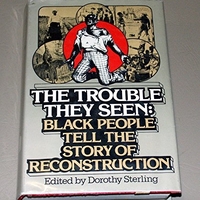 The Trouble They Seen: Black People Tell the Story of Reconstruction
 We Are Your Sisters: Black Women in the Nineteenth Century