-
Title
-
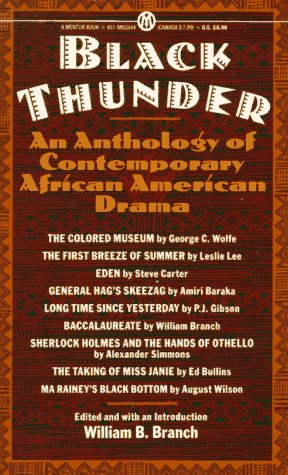
Black Thunder: An Anthology of Contemporary African American Drama
-
This edition
-
"Black Thunder: An Anthology of Contemporary African American Drama" . Ed. William B. Branch. New York: Mentor, 1992. xxxv+520 pp.
-
Table of contents
-
• William B. Branch / Foreword
• William B. Branch / Introduction: The Legacy of the African Grove: From "King Shotaway" to "The Piano Lesson"
• George C. Wolfe / The Colored Museum
• Leslie Lee / The First Breeze of Summer
• Steve Carter / Eden
• Amiri Baraka / General Hag's Skeezag
• P. J. Gibson / Long Time Since Yesterday
• William Branch / Baccalaureate
• Alexander Simmons / Sherlock Holmes and the Hands of Othello
• Ed Bullins / The Taking of Miss Janie
• August Wilson / Ma Rainey's Black Bottom
-
About the anthology
-
• Though the anthology was published in 1992, the foreword is dated "New Rochelle, New York August 24, 1990" (x).
-
• The title uses the term "Black" and the editor's discourse in the foreword and introduction alternates between "Black" (e.g., "Black dramatists" [x], "Black Theater" [xi]) and the newer term "African American" (e.g., "African American drama" [x], "African American Theater" [xi]).
-
Anthology editor(s)' discourse
-
• Branch elaborates on the anthology's title in this manner: "In the long-established multi-cultural traditions of West Africa--from which the ancestors of most African Americans were abducted during the three-centuries long holocaust of the European slave trade--the symbol of power, authority and rule is often the god of thunder: sometimes called 'Shango,' especially by the Yoruba peoples of Nigeria and other nations. Increasingly recognized and respected in other areas of the world as well--in the U.S., the Caribbean and particularly Brazil, which has the largest population of African descent (acknowledged and otherwise)--this deity is prominently invoked on occasions calling for affirmations of truth, vision and service to one's communal grouping. In the spirit of this active connection with the African diaspora, then, this anthology has been titled 'Black Thunder'" (x, n.1).
-
• The nine plays collected in this anthology "were all originally produced in the fifteen-year time span between 1975 and 1990. In effect, they may be referred to as a 'post'-civil-rights-era collection" (ix). This does not mean, however, that these works mark "an end to what has long been called Black 'protest' drama," nor does it "usher in a new era of less confrontational, more 'universal' works than many of those written and produced heretofore" (ix). Nor does it mean the eclipse of a race-conscious literature and the adoption of "a 'humanistic' aesthetic": "the universal and humanistic in art have always been rooted in the particular, and this is no less so for African American theater than for any other artistic entity" (ix).
-
• "Though differing widely in themes, styles and aims, the playwrights in this volume have chosen not to compromise, but to meet head-on the challenge of expressing truth and honesty // about the society in which they live. In their individual ways, they illuminate aspects of life in an historically and fundamentally racist U. S. of A. Even when that fact of life is not overtly mentioned at all, there are nonetheless--for those with eyes to see--the omnipresent racial realities of American history, politics, economics and sociology hovering in the not too distant background, acknowledgment of which is essential for a true understanding of the work at hand" (ix-x).
-
• "Black dramatists" had demonstrated their mastery of the art form "long before the Tony Awards and Pulitzer Prize committees began taking notice of the rich contributions to American theater and literature they had been overlooking. African American drama can be--and oft-times is--as touching and exhilarating as the spirit of the people from which it springs. As Ossie Davis observed in his classic play, 'Purlie Victorious': 'Bein' colored can be a whole lotta fun--when ain't nobody lookin''" (x).
-
• "Included [in this anthology] are plays that easily rank among the best work being done in the American theater. Some are published here for the first time. Most exciting of all, however, is the realization that they do not stand alone; there are many more where these came from" (x).
-
• Branch's introduction discusses the development of "Black Theater--or, as the term is increasingly re-employed, African American Theater" (xi)
-
• Branch tells us that the tradition of Black theater began in the early 19th century, when "Mr. Brown opened a tea garden behind his home on Thomas Street in lower Manhattan, New York City . . . and began presenting 'acts' and 'exhibitionists' for his customers' entertainment" (xi). By 1821, "these occasional entertainments of song, recitals and skits had expanded and grown into a formal organization called the African Company--which, under its leading actor, James Hewlett, had established its own facility at Mercer and Bleeker Streets named the African Grove Theater"--which was "perceived as a potential threat to a long-established white theatrical enterprise in the area: the Park Theater, run by one Stephen Price" (xi).
-
Reviews and notices of anthology
-
• "Publisher's Weekly" 3 Feb. 1992. Web.
"Given the ferment in black theater since 1975, the period covered by this nine-play anthology, the offerings here are disappointing. The opening and closing plays, George C. Wolfe's "The Colored Museum" and August Wilson's "Ma Rainey's Black Bottom", are by far the best works included, the former a coruscating attack on the clichés of black popular culture, the latter a taut examination of the dynamics of a group of black musicians in the late 1920s. What comes in between alternates between family melodramas derivative of O'Neill and Lorraine Hansberry (Steve Carter's "Eden" Leslie Lee's "The First Breeze of Summer") and failed avant-gardism redolent of the Off-Broadway of the early 1960s ("General Hag's Skeezag" by Amiri Baraka and "The Taking of Miss Janie" by Ed Bullins). At their worst, several of the plays here offer casual anti-Semitism (the Baraka and, in a more guarded context, the Bullins) or vicious homophobia (P. J. Gibson's messy "Long Time Since Yesterday"). Playwright Branch's introduction begins promisingly, with an account of the first African American theater ventures, but quickly degenerates into a catalogue of titles and dates." (full text)
-
Publisher's Weekly
-
Commentary on anthology
-
• A collection "valuable for its historical introduction and its headnotes as well as its selection of nine plays produced from 1975 to 1980. Baraka, Bullins, and Wilson are here, of course, as well as George C. Wolfe, Leslie Lee, Steve Carter, P. J. Gibson, Branch himself, and Alexander Simmons" (Kinnamon 1997: 476).
-
See also
-
• "William Branch, Playwright Who Explored African American Life Dies at 92." "Washington Post" 6 Nov. 2019.
-
• Branch, William, ed. "Crosswinds: An Anthology of Black Dramatists in the Diaspora." Bloomington: Indian UP, 1993.
This anthology is not included in this project since less than half of the material in it is by African American authors. Nonetheless, it is an obvious complement to Branch's "Black Thunder" (1992). The contents of "Crosswinds" are listed below:
Black dramatists in the diaspora : the beginnings / William B. Branch -- Death and the king's horseman / Wole Soyinka -- Edufa / Efua Sutherland -- Woza Albert / Percy Mtwa, Mbongeni Ngema, and Barney Simon -- Pantomime / Derek Walcott -- Lament for Rastafari / Edgar White -- Sortilege II : Zumbi returns / Abdias do Nascimento -- Slave Ship / Amiri Baraka -- In splendid error / William Branch -- Joe Turner's come and gone / August Wilson --The talented tenth / Richard Wesley
-
Cited in
-
Kinnamon 1997: 476]
-
Item Number
-
A0269
 Front cover