Singers in the Dawn: A Brief Supplement to the Study of American Literature; repr. as Singers in the Dawn: A Brief Anthology of Negro Poetry
Item
-
Title
-
Singers in the Dawn: A Brief Supplement to the Study of American Literature; repr. as Singers in the Dawn: A Brief Anthology of Negro Poetry
-
This edition
-
"Singers in the Dawn: A Brief Supplement to the Study of American Literature" . Ed. Robert B. Eleazor. Atlanta: Conference on Education and Race Relations, 1934. 23 pp. ["First edition, 5000, June, 1934." Cost 10 cents.]
-
Other editions, reprints, and translations
-
Repr. as "Singers in the Dawn: A Brief Anthology of Negro Poetry" ("2nd ed." 10,000, January, 1935; "3rd ed." 10,000, July, 1936; "4th ed." 10,000, November, 1937; "5th ed." 10,000 copies, Feb. 1939, 10 cents per copy, $1.00 per dozen; "6th ed." 1942; "7th ed." Atlanta: Commission on Interracial Cooperation, 1943).
-
Online access
-
5th ed. (1939) available via Internet Archive:
-
Internet Archive
-
2nd ed. (1935) available via African American Biographical Database (Chadwyck-Healey) (subscription required)
-
Table of contents
-
• Although the second and subsequent printings call the work a "brief anthology" of Negro poetry, this work is better characterized as an introductory survey of poetry by African American authors, with sample excerpts from many of the poets mentioned, but few whole poems. The survey (pp. 3-22) is followed by a one-page account of "The Negro Spiritual" by Prof. Frederick Hall (Dillard U, New Orleans).
-
Anthology editor(s)' discourse
-
• Foreword: "A few decades ago the map of the world which we studied in school still showed great uncharted areas marked 'unknown.' A recent examination of thirty-eight volumes on American literature—textbooks and anthologies—revealed a similar unexplored area of literary attainment [i.e. African American literature]. In most of these books this region was not even marked unknown—it was simply ignored, as if it were not there at all.
"Yet, even a hurried adventure into that area reveals a unique and interesting realm of literary art, and suggests rich possibilities as yet unrealized. To introduce the inquiring student to this new land, which is the purpose of this little volume, is a service he will appreciate increasingly as he explores further.
"The compiler makes no pretense of original research or critical authority. He cheerfully confesses his debt to the three or four anthologies covering this field, notably 'Negro Poets and Their Poems' by Thomas [sic, Robert] A. Kerlin [1923], 'An Anthology of Verse by American Negroes' by White and Jackson [1924], 'The Book of American Negro Poetry' by James Weldon Johnson [1922], and 'Caroling Dusk' by Countee Cullen [1927]. Each of these collections is an excellent piece of work; any one or all of them are recommended to those wishing to go further into the subject. For authority to quote, we are indebted to Dodd, Mead and Company, Harper and Brothers, and Harcourt, Brace and Company" (2).
-
• Links to the anthologies Eleazer draws on:
-
 Negro Poets and Their Poems
-
 Anthology of Verse by American Negroes
-
 Book of American Negro Poetry
-
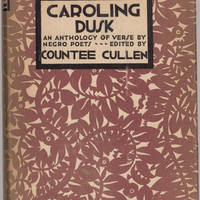 Caroling Dusk: An Anthology of Verse by Negro Poets
-
Commentary on anthology
-
• Eleazer's reference in his foreword to a "recent examination of thirty-eight volumes on American literature" (2) alludes to his brief report on "School Books and Racial Antagonism: A Study of Omissions and Inclusions That Make for Misunderstanding" (Atlanta: Executive Committee, Conference on Education and Race Relations, 1935; 3rd printing, 1937). In that work, Eleazer notes: “A review of thirty-eight volumes of American literature texts and selected readings reveals a situation only slightly more favorable than that found in the textbooks on history and civics. Twenty-five of the thirty-eight volumes, or approximately two-thirds, contain no suggestion that the Negro has ever made the least contribution to the literature of America. Of the other thirteen volumes, eight mention briefly only a single Negro writer each, either Phillis Wheatley or Paul Laurence Dunbar; one names them both. One of the thirteen contents itself with a single line, another with six; one quotes a few lines of a Negro spiritual. Three books mention three or more Negro writers. The most generous of the series accords to Negro literature one chapter of three pages. The next three in order give the subject only three pages between them. None of the other nine devotes more than a single brief paragraph to the Negro’s literary accomplishments. A three-volume set of quotations from American poets, twenty-six hundred pages, quotes not a line from any Negro author. A nine-volume anthology has a single brief quotation from Dunbar. Two other anthologies of a thousand pages and more make no mention of Negro authorship; still another, equally voluminous, contains only one brief anonymous quotation, a spiritual” (8). Most of the 38 anthologies and readers "simply ignore the whole subject, leaving the student entirely without knowledge of the unique contributions which more than a score of Negroes have made to the literature of America" (8).
-
HathiTrust
-
See also
-
• Eleazer, Robert B. "America's Tenth Man: A Brief Survey of the Negro's Part in American History." Atlanta: Commission on Interracial Cooperation, 1943.
-
Internet Archive
-
• Sosna, Morton. "The Commission on Interracial Cooperation." "In Search of the Silent South: Southern Liberals and the Race Issue." New York: Columbia UP, 1977. 20-41.
-
• Ellis, Mark. "Interracial Cooperation and Southern Education between the Wars: Robert B. Eleazer and the Conference on Education and Race Relations." "American Educational History Journal" 47.2 (2020): 143-59.
Abstract: "Robert Burns Eleazer (1877-1973), a liberal white Methodist from Tennessee, served as the education director and director of publicity of the Atlanta-based Commission on Interracial Cooperation (CIC) from 1922 to 1942. As education director, he developed a strategy for improving race relations which entailed offering prizes to young people in the southern states for essays on racial minorities in American life and culture. Eleazer's role as the CIC's director of publicity meant constant communication with regional and national journals about lynching and its prevention, poverty, migration, policing, and justice in the courts. He also attempted to radically alter the social studies and civics curriculum in southern education. This article attempts to shed light on the CIC's education work and Eleazer's role and motives in devising and distributing his programs. It also shows how a regional effort to alter the outlook of a new generation concerning respect and human equality predated the intercultural education movement's attempts to do this on a larger scale after 1940 (Halvorsen and Mirel 2013). As such, it offers insights into a possible legacy of the interracial cooperation movement that followed World War I, to the civil rights movement that followed World War II."
-
• Pullen, Ann. "Commission on Interracial Cooperation." "New Georgia Encyclopedia" 5 April 2021.
-
New Georgia Encyclopedia
-
Cited in
-
• Lash 1946: 724.
• [not in Kinnamon 1997]
-
Item Number
-
A0034

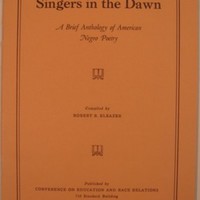 Front cover